
 9560025568
 drbhavanasingla@gmail.com


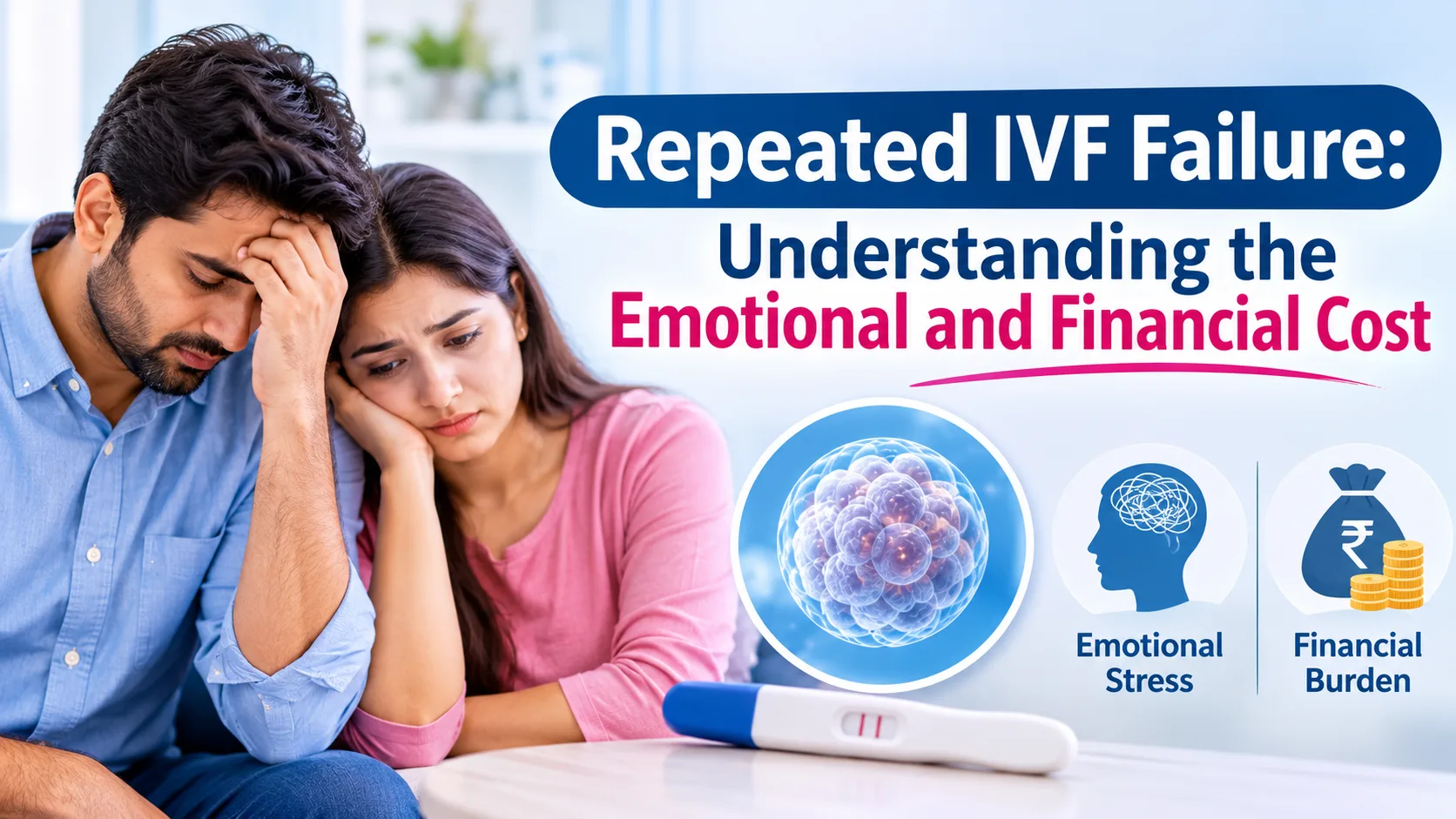
The Emotional and Financial Cost of Repeated IVF Failure: What Every Couple Should Know
For couples struggling with infertility, starting IVF treatment often brings new hope. After months or even years of trying to conceive, IVF may feel like an important step towards becoming parents.
Couples prepare themselves physically, emotionally and financially for the treatment. They attend appointments, take medications, undergo procedures and wait for the day when they finally see a positive pregnancy test.
But what happens when the IVF cycle fails?
And what happens when it fails more than once?
Repeated IVF failure can be one of the most difficult experiences for a couple. The disappointment is not limited to a negative pregnancy test. It can affect mental health, relationships, family life, career decisions and financial stability.
In India, where many couples pay for fertility treatment from their own savings, repeated IVF cycles can also create considerable financial pressure.
However, one important thing every couple should understand is that an unsuccessful IVF cycle does not mean that you can never become parents. It also does not mean that the next IVF cycle will necessarily fail.
Understanding what happened, reviewing the treatment and making informed decisions can help couples move forward with greater confidence.
Let’s understand the emotional and financial challenges of repeated IVF failure and what couples can do before planning another treatment cycle.
1. The Emotional Impact of Repeated IVF Failure
IVF treatment involves much more than medical procedures. Every cycle carries expectations, excitement and emotional investment.
When the pregnancy test is negative, couples may experience several emotions at the same time.
Disappointment After Every Unsuccessful Cycle
The first unsuccessful IVF cycle can be difficult to accept. Couples may initially believe that trying again will solve the problem.
However, when another cycle is unsuccessful, disappointment can become more intense.
Patients may start asking themselves:
- Why is this happening to us?
- Did we do something wrong?
- Will we ever have a baby?
- How many more times should we try?
- Is there something wrong with my body?
These thoughts are understandable, but patients should remember that IVF outcomes depend on several biological and medical factors. An unsuccessful cycle is not necessarily anyone’s fault.
Anxiety Before Starting Another IVF Cycle
After experiencing failure, even thinking about another IVF cycle can create anxiety.
Patients may worry about injections, egg retrieval, embryo development and the pregnancy test result.
Some women become particularly anxious during the two-week waiting period after embryo transfer.
The fear of hearing another negative result can sometimes become more difficult than the treatment itself.
It is important to discuss these concerns with your fertility specialist rather than keeping them to yourself.
Feeling Emotionally Exhausted
Repeated IVF cycles can make couples feel physically and mentally tired.
The continuous cycle of medical appointments, medications, waiting periods and uncertain outcomes can affect everyday life.
Some patients may lose interest in social activities, avoid conversations about pregnancy or feel uncomfortable attending family gatherings.
Taking time to recover emotionally between treatment cycles is perfectly reasonable.
You do not have to rush into another IVF cycle simply because the previous one was unsuccessful.
2. How Repeated IVF Failure Can Affect a Marriage
Infertility affects both partners, but they may experience and express their emotions differently.
One partner may want to try another IVF cycle immediately, while the other may need time to recover emotionally.
This difference can sometimes lead to misunderstandings.
Common relationship challenges include:
- Disagreements about continuing IVF treatment.
- Financial stress between partners.
- Feelings of guilt or responsibility.
- Reduced emotional and physical intimacy.
- Difficulty discussing treatment failures.
- Pressure from family members.
For example, a woman may feel that her body has failed her, while her husband may feel helpless because he cannot remove her emotional pain.
In such situations, couples should try to approach infertility as a shared journey rather than placing responsibility on one partner.
A useful approach: Set aside time to talk openly about your feelings without discussing medical reports or the next treatment decision every time.
Sometimes, simply listening to each other can make a meaningful difference.
3. The Financial Cost of Repeated IVF Cycles in India
One of the biggest challenges associated with repeated IVF treatment is the financial burden.
IVF involves several components, including:
- Initial fertility investigations.
- Hormonal medications and injections.
- Ultrasound monitoring and blood tests.
- Egg retrieval procedures.
- Laboratory fertilisation and embryo culture.
- Embryo freezing and storage, when required.
- Embryo transfer procedures.
- Additional investigations or treatments, if medically indicated.
The total cost depends on the patient’s medical condition, treatment protocol, medication requirements, clinic and laboratory services.
When one IVF cycle is unsuccessful, couples may need to spend additional money on another cycle or a frozen embryo transfer, depending on their circumstances.
Why Repeated IVF Treatment Can Affect Family Savings
Many couples in India use personal savings to finance fertility treatment.
Some may postpone buying a home, delay other financial goals or use their savings intended for future family expenses.
Others may borrow money from relatives or take personal loans to continue treatment.
A 2026 study published on out-of-pocket expenditure among couples undergoing IVF at selected Indian hospitals reported average expenses of approximately:
- ₹1.10 lakh per IVF cycle in the participating public hospitals.
- ₹2.31 lakh per IVF cycle in the participating private hospitals.
The study also found that many couples relied on external financial support, while a significant proportion experienced substantial financial hardship.
These figures represent the study participants and should not be treated as standard IVF prices across India. Actual costs vary between hospitals and individual treatment plans.
The important point is that repeated treatment can create a considerable financial burden, particularly when couples have limited insurance coverage.
Hidden Costs Couples Should Consider
Apart from the main IVF package, patients should also consider expenses that may not be included in the initial quotation.
For example:
- Additional medicines during ovarian stimulation.
- Repeat blood investigations and ultrasound scans.
- Embryo freezing and annual storage charges.
- Frozen embryo transfer expenses.
- Travel and accommodation costs.
- Time away from work and loss of income.
- Additional procedures when medically necessary.
Before starting treatment, ask the clinic for a detailed cost estimate and clarify what is included and what may require additional payment.
4. Why Does IVF Fail Repeatedly?
This is one of the most common questions asked by couples after unsuccessful IVF treatment.
There is no single explanation for every IVF failure. Several factors can influence whether an embryo implants and develops into a pregnancy.
1. Embryo Chromosomal Abnormalities
An embryo may appear healthy under a microscope but still have an abnormal number of chromosomes.
Chromosomal abnormalities are an important reason why some embryos fail to implant or develop further. Their likelihood is influenced by factors including maternal age.
2. Egg Quality and Ovarian Factors
Age, ovarian reserve and individual reproductive health can influence egg development and the number of embryos available for transfer.
However, a low AMH level alone does not mean that pregnancy through IVF is impossible.
3. Sperm-Related Factors
Sperm health also plays an important role in fertilisation and embryo development.
Sperm count, movement, morphology and certain other male fertility factors may influence IVF outcomes.
4. Uterine and Endometrial Factors
The uterus provides the environment in which an embryo implants and develops.
Conditions such as uterine polyps, certain fibroids, adhesions, adenomyosis and other uterine abnormalities may need evaluation depending on the patient’s history and clinical findings.
5. Other Medical and Treatment-Related Factors
Hormonal conditions, ovarian response, embryo development, transfer-related factors and individual medical circumstances may also influence the outcome.
It is important to understand that sometimes no clear reason for an unsuccessful IVF cycle can be identified, even after appropriate evaluation.
Not every failed IVF cycle indicates a medical problem that requires extensive testing.
5. Should You Immediately Start Another IVF Cycle After Failure?
Not necessarily.
After an unsuccessful cycle, some couples want to begin treatment again as soon as possible. Others need time to recover physically, emotionally and financially.
Both approaches can be reasonable, depending on individual circumstances.
Before planning another cycle, your fertility specialist should review the previous treatment in detail.
This may include:
Reviewing the ovarian stimulation response: How did the ovaries respond to the medications? Were the number and development of eggs as expected?
Reviewing fertilisation results: How many eggs were mature, and how many fertilised successfully?
Reviewing embryo development: How many embryos developed, and what was their quality at the time of transfer or freezing?
Reviewing the embryo transfer: Was the transfer technically straightforward? Were there any concerns during the procedure?
Reviewing uterine health: Is any further assessment of the uterine cavity or endometrium appropriate?
Reviewing previous medical history: Are there any underlying conditions or treatment-related factors that need attention?
This review helps the doctor understand whether any part of the treatment plan needs adjustment.
The next cycle should be based on medical findings rather than simply repeating the previous protocol without evaluation.
6. Which Tests Are Necessary After Repeated IVF Failure?
Not every patient needs an extensive list of additional tests after an unsuccessful IVF cycle.
The investigations should depend on the number of failed transfers, previous reports, age, medical history and clinical findings.
Depending on the situation, a fertility specialist may consider:
| Investigation | Why it may be considered |
|---|---|
| Hormonal evaluation | To assess relevant hormonal conditions |
| Pelvic ultrasound | To examine the uterus and ovaries |
| Uterine cavity assessment | To identify possible structural abnormalities |
| Semen analysis | To review male fertility parameters |
| Thyroid testing | When clinically indicated |
| Genetic counselling | When personal or family history suggests a genetic concern |
Additional investigations such as hysteroscopy or genetic testing may be appropriate in selected cases.
However, tests such as routine immune panels, ERA testing and several proposed IVF add-ons have not demonstrated sufficient evidence for routine use in every patient with failed IVF treatment.
The aim should be to identify a meaningful medical concern, not to perform every available test.
7. How Can Couples Manage the Emotional Stress of Repeated IVF Failure?
Emotional well-being deserves attention just as much as physical health during fertility treatment.
Here are some practical ways couples can take care of themselves.
Give Yourself Time to Recover
You do not have to make your next treatment decision immediately after receiving a negative result.
Allow yourself time to process the disappointment and discuss your feelings with your partner.
Consider Professional Counselling
An infertility counsellor or mental health professional can help couples manage anxiety, grief, uncertainty and relationship difficulties.
Counselling is not a sign of weakness. It is a form of support during a challenging medical journey.
Avoid Comparing Your Journey With Others
Every couple has a different fertility history.
Someone else’s successful IVF cycle does not mean that your treatment should follow the same timeline or produce the same result.
Avoid judging your progress through other people’s pregnancy announcements or social media stories.
Set Boundaries With Family and Friends
Questions such as “When will you have a baby?” or “Why are you not trying again?” can be emotionally painful.
It is perfectly acceptable to tell family members that you prefer not to discuss your treatment details.
Maintain Everyday Routines
Try to maintain regular sleep, balanced meals, gentle physical activity and activities that help you relax.
These habits support general well-being, although they cannot guarantee IVF success.
If emotional distress becomes overwhelming or affects your ability to manage everyday activities, seek professional support.
8. How to Plan Your Next IVF Cycle Without Unnecessary Financial Pressure
A well-planned treatment approach can help couples avoid unexpected expenses and make more informed decisions.
Consider the following steps before starting another IVF cycle.
Step 1: Collect Previous IVF Reports
Keep copies of your previous stimulation charts, hormone reports, egg retrieval details, fertilisation reports, embryo grading reports and embryo transfer records.
These documents help your fertility specialist understand what happened during previous cycles.
Step 2: Understand the Reason for Every Recommended Procedure
Ask why a particular test, medicine or additional procedure is being suggested.
Understand whether it is essential for your medical condition or optional.
Step 3: Request a Detailed Cost Estimate
Ask for a written estimate that includes medications, laboratory procedures, embryo freezing, storage and possible additional expenses.
Step 4: Discuss the Available Treatment Options
Depending on your medical condition, options may include another stimulation cycle, frozen embryo transfer, additional evaluation or a change in treatment approach.
Step 5: Decide on a Financial Limit
Discuss how much you can comfortably allocate to treatment without placing your household finances under excessive pressure.
Avoid taking financial decisions under emotional pressure or making commitments based on guaranteed pregnancy claims.
9. Does Repeated IVF Failure Mean You Should Stop Trying?
This is a deeply personal question, and there is no universal answer.
Some couples may benefit from another IVF attempt after reviewing their previous treatment.
Others may need a medical break, further evaluation or time to consider different family-building options.
The decision depends on several factors:
- Woman’s age and ovarian reserve.
- Number and quality of available embryos.
- Previous IVF treatment outcomes.
- Underlying cause of infertility.
- Medical prognosis.
- Emotional readiness.
- Financial circumstances.
It is also important to remember that stopping treatment temporarily does not mean giving up on parenthood.
Couples should have the freedom to decide what is medically, emotionally and financially appropriate for them.
10. How Fertility Specialists Can Support Couples Beyond Medical Treatment
Successful fertility care should not focus only on egg retrieval, fertilisation and embryo transfer.
Patients also need clear communication, realistic expectations and emotional support.
A fertility specialist should help couples understand:
- What happened during the previous IVF cycle.
- Whether further investigations are necessary.
- Which treatment options are available.
- What the realistic expectations are.
- What additional procedures may cost.
- Whether emotional counselling could be helpful.
Couples should feel comfortable asking questions and discussing their concerns without feeling rushed into another treatment cycle.
The goal is not simply to perform more IVF cycles. It is to help patients make informed decisions throughout their fertility journey.