
 9560025568
 drbhavanasingla@gmail.com


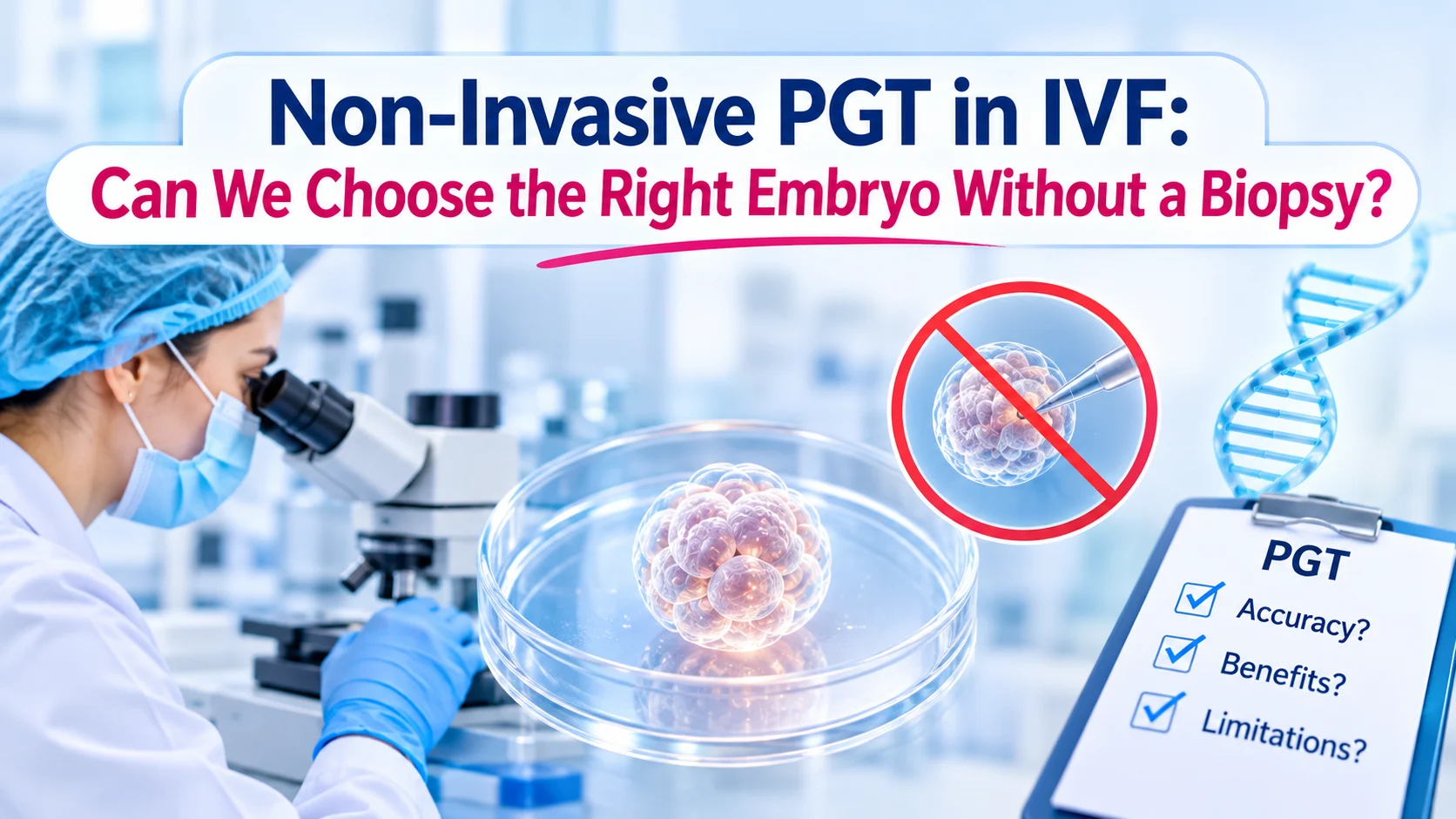
IVF technology is continuously evolving, bringing new techniques that aim to make fertility treatment safer and more effective. One such development is Non-Invasive Preimplantation Genetic Testing (niPGT).
Traditionally, genetic testing of embryos during IVF involves removing a small number of cells from an embryo for laboratory analysis. Non-invasive PGT aims to examine genetic material released by the embryo without performing this biopsy.
For couples undergoing IVF, this sounds like an attractive option. After all, if doctors can obtain genetic information without touching the embryo, could it make embryo selection safer and improve pregnancy chances?
However, an important question remains: Is non-invasive PGT accurate enough to identify the right embryo for transfer?
Let’s understand how this technology works, what makes it different from conventional PGT, and whether patients should consider it during IVF treatment.
What Is Non-Invasive PGT in IVF?
Non-Invasive Preimplantation Genetic Testing (niPGT) is a laboratory technique designed to examine genetic material released by an embryo during its development.
During IVF, eggs are fertilised with sperm in a specialised laboratory. The resulting embryos are cultured under controlled conditions until they reach the appropriate developmental stage.
As embryos develop, small amounts of DNA may be released into the surrounding environment. This genetic material is called cell-free DNA (cfDNA).
Non-invasive PGT attempts to collect and analyse this DNA to identify possible chromosomal abnormalities without removing cells directly from the embryo.
The main objective is to obtain genetic information while avoiding an embryo biopsy.
How Does Non-Invasive PGT Work?
Non-invasive PGT generally involves two approaches:
1. Testing Spent Embryo Culture Medium
Embryos are grown in a specialised culture medium inside the IVF laboratory.
During development, some genetic material may be released into this medium. After the embryo is transferred to another suitable environment or prepared for freezing, the used culture medium can be collected for laboratory analysis.
The collected sample is examined using advanced genetic testing methods to look for chromosomal abnormalities.
2. Testing Blastocoel Fluid
A developing blastocyst contains a fluid-filled cavity called the blastocoel.
Researchers have explored collecting a small amount of this fluid and analysing the genetic material present in it.
Both methods aim to obtain genetic information without taking a conventional tissue biopsy from the embryo.
However, the amount and quality of DNA available for testing can vary, which creates challenges in obtaining accurate results.
Non-Invasive PGT vs Conventional PGT-A: What Is the Difference?
To understand niPGT, it is helpful to compare it with conventional PGT-A.
PGT-A stands for Preimplantation Genetic Testing for Aneuploidy. It examines the number of chromosomes in a sample of cells taken from an embryo.
Humans normally have 46 chromosomes arranged in 23 pairs. An abnormal chromosome number is known as aneuploidy and may affect embryo development and pregnancy outcomes.
Here is how the two approaches differ:
| Feature | Conventional PGT-A | Non-Invasive PGT |
|---|---|---|
| Sample | Cells removed from embryo | DNA from culture medium or blastocoel fluid |
| Embryo biopsy | Required | Not required |
| DNA availability | Generally more suitable for analysis | May be limited |
| Accuracy | Has recognised limitations | Currently less reliable |
| Clinical use | Used in selected cases | Not recommended for routine clinical use at present |
It is important to remember that conventional PGT-A also has limitations. A biopsy examines a small sample of cells and may not perfectly represent every cell in the embryo.
What Are the Potential Benefits of Non-Invasive PGT?
The technology has generated interest because of several possible advantages.
1. No Conventional Embryo Biopsy
One of the biggest attractions is that it does not require the removal of cells from the embryo for testing.
This may help avoid the potential physical risks associated with embryo biopsy.
2. Less Direct Handling of the Embryo
Since the testing uses material collected from the culture environment, the embryo does not need to undergo a biopsy specifically for niPGT.
3. Potential for Easier Genetic Screening
If researchers can improve its accuracy, this technique may offer another approach to obtaining genetic information during IVF.
4. Future Possibility of Better Embryo Assessment
With further research and technological improvements, niPGT may become a useful tool in reproductive medicine.
However, these are potential advantages, not established clinical benefits. Avoiding biopsy alone does not prove that a testing method can correctly identify the healthiest embryo.
Is Non-Invasive PGT Reliable for Choosing an Embryo?
This is the most important question for couples considering IVF.
Although non-invasive PGT is promising, its accuracy remains a major concern.
There are several reasons why the results may not always match the actual chromosome status of an embryo.
1. Risk of DNA Contamination
The genetic material collected from the culture medium may not always come exclusively from the embryo.
It can potentially contain DNA from maternal cells, sperm or other external sources.
This contamination can affect the test results and lead to incorrect genetic interpretations.
2. Embryo Mosaicism
Some embryos contain a mixture of cells with different chromosome patterns. This condition is called mosaicism.
The DNA released into the culture medium may not accurately represent the genetic composition of the entire embryo.
As a result, the test could report an abnormal result even when the embryo contains cells with a normal chromosome number, or vice versa.
3. Limited DNA Quantity
The amount of DNA released by an embryo can be very small.
When the available genetic material is insufficient, laboratory amplification techniques may be required. These processes can introduce technical errors and affect the reliability of the final report.
4. False Positive and False Negative Results
A false positive result means the test suggests that an embryo has a chromosomal abnormality when it may actually have a normal chromosome pattern.
A false negative result means the test does not identify an abnormality that is actually present.
Both situations can create problems during embryo selection.
For example, a potentially viable embryo could be rejected because of an incorrect abnormal result.
This is why accuracy is particularly important when a test result determines which embryo will be transferred.
What Do Indian Fertility Organisations Say About Non-Invasive PGT?
This is an especially important consideration for IVF patients in India.
A joint position statement from the Indian Society for Assisted Reproduction (ISAR), Indian Fertility Society (IFS) and Academy of Clinical Embryologists (ACE) advises against using non-invasive PGT in routine clinical practice at present.
The recommendation applies to testing using both spent embryo culture medium and blastocoel fluid.
The organisations highlighted concerns about diagnostic accuracy, false positive and false negative results, and the absence of conclusive evidence showing improved implantation, pregnancy or live birth rates.
The statement also advises against using niPGT for embryo ranking or selecting embryos for transfer in its current form.
This means that patients should be cautious if non-invasive PGT is presented as a proven method of identifying the best embryo.
The technology has potential, but more research and validation are needed before it can be considered reliable for routine clinical decisions.
Does Non-Invasive PGT Guarantee a Successful IVF Pregnancy?
No. Neither non-invasive PGT nor conventional PGT-A can guarantee pregnancy or the birth of a healthy baby.
Pregnancy outcomes depend on several factors, including:
- Woman’s age and reproductive health.
- Egg quality and ovarian reserve.
- Sperm quality.
- Embryo development and quality.
- Uterine health and endometrial conditions.
- Other medical and genetic factors.
Even an embryo reported as chromosomally normal through conventional PGT-A may not implant or result in a successful pregnancy.
Similarly, a non-invasive PGT result should not be treated as a final confirmation of an embryo’s genetic health.
Genetic testing during IVF is a screening and assessment process, not a guarantee of reproductive success.
Should You Choose Non-Invasive PGT During IVF Treatment?
At present, non-invasive PGT should not be used as the deciding test for choosing an embryo for transfer in routine IVF practice.
If a fertility clinic offers this procedure, patients should ask about its diagnostic accuracy, validation, false result rates and whether its use is supported by current professional recommendations.
Depending on the patient’s medical history, a fertility specialist may discuss other appropriate genetic testing options.
For example:
- PGT-A: Evaluates chromosome number in an embryo biopsy sample.
- PGT-M: Used to test for specific inherited single-gene conditions when indicated.
- PGT-SR: Used to assess certain structural chromosome rearrangements.
These tests have different purposes and should not be considered interchangeable.
A fertility specialist and genetic counsellor can help determine whether any genetic testing is appropriate for a particular couple.
Final Thoughts: Promising Technology, But Is It Ready for IVF Patients?
Non-Invasive PGT is an interesting development in reproductive medicine. Its aim to obtain embryo genetic information without conventional biopsy makes it an attractive area of research.
However, scientific progress should always be supported by reliable evidence before a new technology becomes part of routine patient care.
Current evidence and the joint recommendations of Indian fertility organisations do not support using niPGT for clinical embryo selection at present.
For couples planning IVF, the best approach is to understand the available treatment options, ask questions about additional procedures and make decisions based on individual medical needs.
At Dr. Bhavana Singla’s fertility practice in Moti Nagar, Delhi, the focus is on helping couples understand their fertility concerns and make informed decisions about IVF and available treatment options.
Remember, choosing the right IVF treatment is not about using every new technology. It is about selecting an approach that is medically appropriate, scientifically supported and suitable for your individual fertility journey.