
 9560025568
 drbhavanasingla@gmail.com


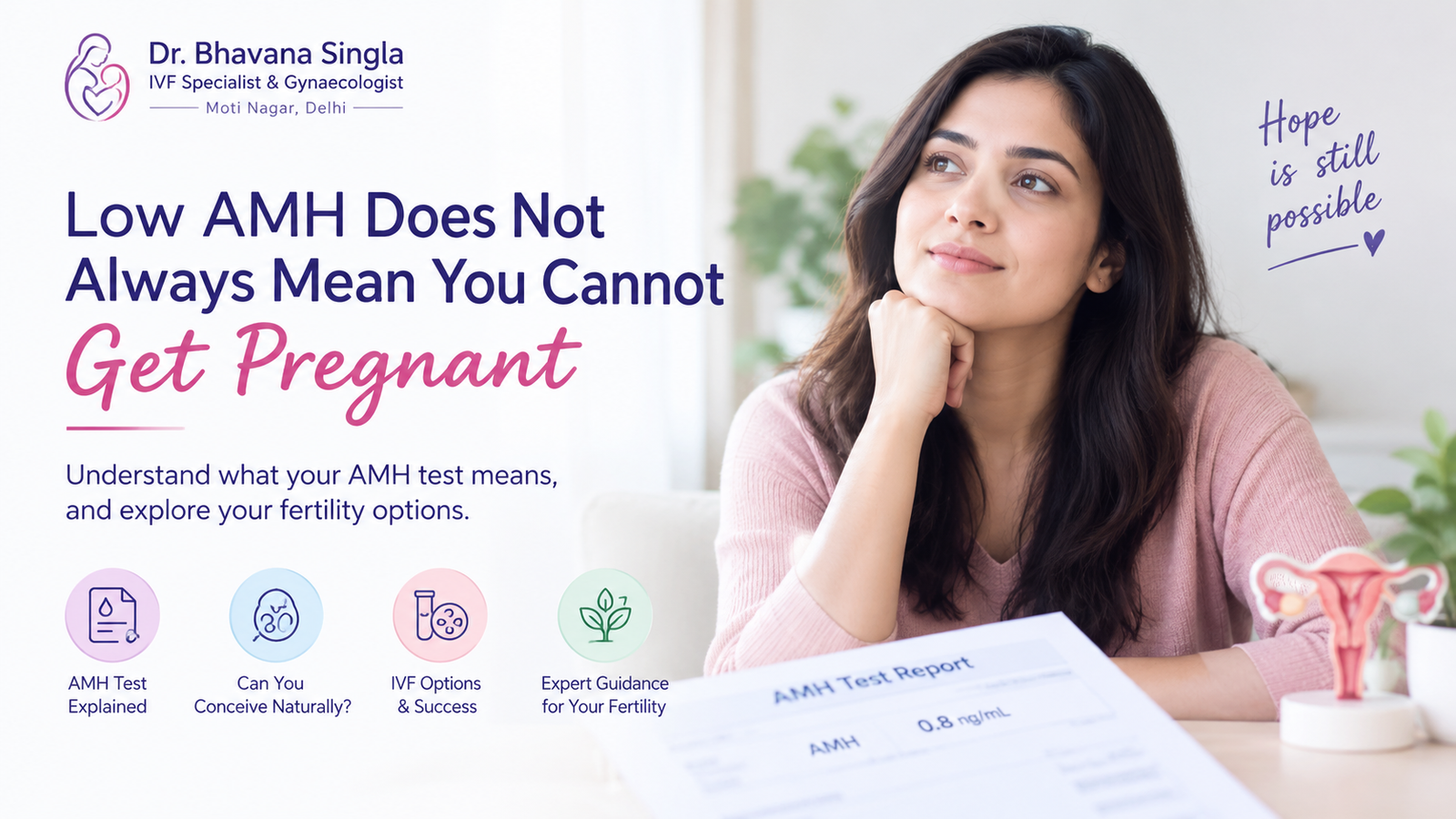
Have you recently received a blood test report showing low AMH and started worrying about your chances of becoming a mother? You are not alone. Many women feel anxious when they learn that their Anti-Müllerian Hormone (AMH) level is lower than expected.
However, low AMH does not automatically mean you cannot get pregnant. It is a marker of ovarian reserve, which refers to the remaining supply of eggs in the ovaries. While this information helps a fertility specialist plan treatment, it cannot determine your individual chances of pregnancy on its own.
Understanding your report and seeking the right medical advice can help you make informed decisions about your fertility.
What Is AMH and Why Is It Important?
Anti-Müllerian Hormone (AMH) is produced by cells surrounding small developing follicles in the ovaries. An AMH blood test helps doctors estimate ovarian reserve and understand how the ovaries may respond to fertility medications during treatment such as In Vitro Fertilisation (IVF).
AMH is useful, but it has limitations. It does not directly measure egg quality, confirm whether you can conceive naturally, or tell you exactly when you will reach menopause.
According to the American Society for Reproductive Medicine (ASRM), AMH is more useful for predicting the number of eggs that may be obtained during IVF than for independently predicting pregnancy or live birth.
Can You Get Pregnant Naturally With Low AMH?
Yes, natural pregnancy can still be possible with low AMH.
Some women with low AMH conceive naturally, particularly when other important fertility factors are favourable. However, low AMH may indicate a reduced number of eggs available, which can make fertility planning more time-sensitive.
Your chances depend on several factors, including:
- Age: Egg quality and fertility generally decline with age.
- Ovulation: Whether an egg is released during your menstrual cycle.
- Fallopian tubes: Whether the tubes are open and functioning.
- Sperm health: The sperm count, movement and other relevant semen parameters.
- Duration of trying: How long you have been attempting to conceive.
- Other reproductive conditions: Such as endometriosis or certain uterine problems.
Therefore, an AMH result should always be interpreted alongside your medical history and other fertility investigations.
What Is Considered a Low AMH Level?
There is no single AMH number that can determine whether a woman will or will not become pregnant. Laboratories may use different reference ranges, and interpretation depends on the test method, age and clinical circumstances.
A fertility specialist may consider AMH alongside an antral follicle count (AFC), which is measured by ultrasound. Other tests, such as FSH and estradiol, may also be appropriate in selected cases.
Do not compare your result with someone else’s report or make treatment decisions based on an online AMH chart alone.
Does Low AMH Mean You Need IVF?
Not necessarily. IVF is one possible treatment, but it is not automatically required for every woman with low AMH.
Your doctor may recommend different approaches depending on your age, how long you have been trying to conceive, whether you ovulate, your partner’s fertility results and the condition of your fallopian tubes.
Depending on the complete assessment, options may include:
- Trying naturally for an appropriate period: This may be reasonable for selected women after fertility evaluation.
- Ovulation-related treatment: When an ovulation problem is identified.
- Intrauterine insemination (IUI): In selected cases where the other fertility factors are suitable.
- In Vitro Fertilisation (IVF): This may be considered when clinically appropriate, particularly when age, other infertility factors or the overall assessment support moving to assisted reproduction.
Low AMH can help your fertility specialist anticipate a potentially lower response to ovarian stimulation during IVF. It should not, by itself, be treated as proof that IVF cannot work.
Can IVF Be Successful With Low AMH?
IVF may still be an option for women with low AMH. However, the likely response to medication and the expected outcomes vary from person to person.
A lower ovarian reserve may mean that fewer eggs are collected during an IVF cycle. In some cases, fewer eggs may result in fewer embryos available for transfer. This can affect the overall treatment plan.
Your doctor will consider factors such as:
- Your age and previous fertility history.
- Your AMH result and antral follicle count.
- Your response to any previous IVF stimulation.
- Sperm parameters and embryo development.
- Your overall health and individual treatment goals.
It is important to understand that no AMH value can guarantee IVF success or failure. Ask your specialist to explain the likely benefits, limitations, costs and alternatives before deciding on treatment.
Can Low AMH Be Increased Naturally?
There is currently no established natural remedy, diet or supplement proven to reliably restore ovarian reserve or reverse age-related loss of eggs.
A balanced diet, regular physical activity, adequate sleep and avoiding smoking can support general health and reproductive wellbeing. However, these habits should not be presented as a guaranteed way to increase AMH or improve pregnancy chances.
Do not start fertility supplements, hormonal medicines or other treatments without discussing them with your doctor. A change in AMH alone does not necessarily mean that egg quality or fertility has improved.
When Should You Consult an IVF Specialist?
Consider a fertility consultation if your AMH result is low and you are planning a pregnancy, particularly if you are 35 or older, have irregular periods, have been trying to conceive without success, or have a history of ovarian surgery or fertility treatment.
As a general guideline, women under 35 are often advised to seek an infertility evaluation after 12 months of trying, while women aged 35 or older should generally seek evaluation after six months. Women over 40 or those with known fertility risk factors may benefit from earlier assessment.
You do not need to wait for these time periods if your doctor has already identified a potential fertility concern.
Consult Dr. Bhavana Singla for Fertility Guidance in Delhi
A low AMH report can be worrying, but it does not tell your entire fertility story. The next step is to understand what the result means for your age, reproductive health and pregnancy plans.
Dr. Bhavana Singla, IVF Specialist and Gynaecologist in Delhi, can assess your fertility concerns and help you understand the available investigation and treatment options based on your individual medical history.