
 9560025568
 drbhavanasingla@gmail.com

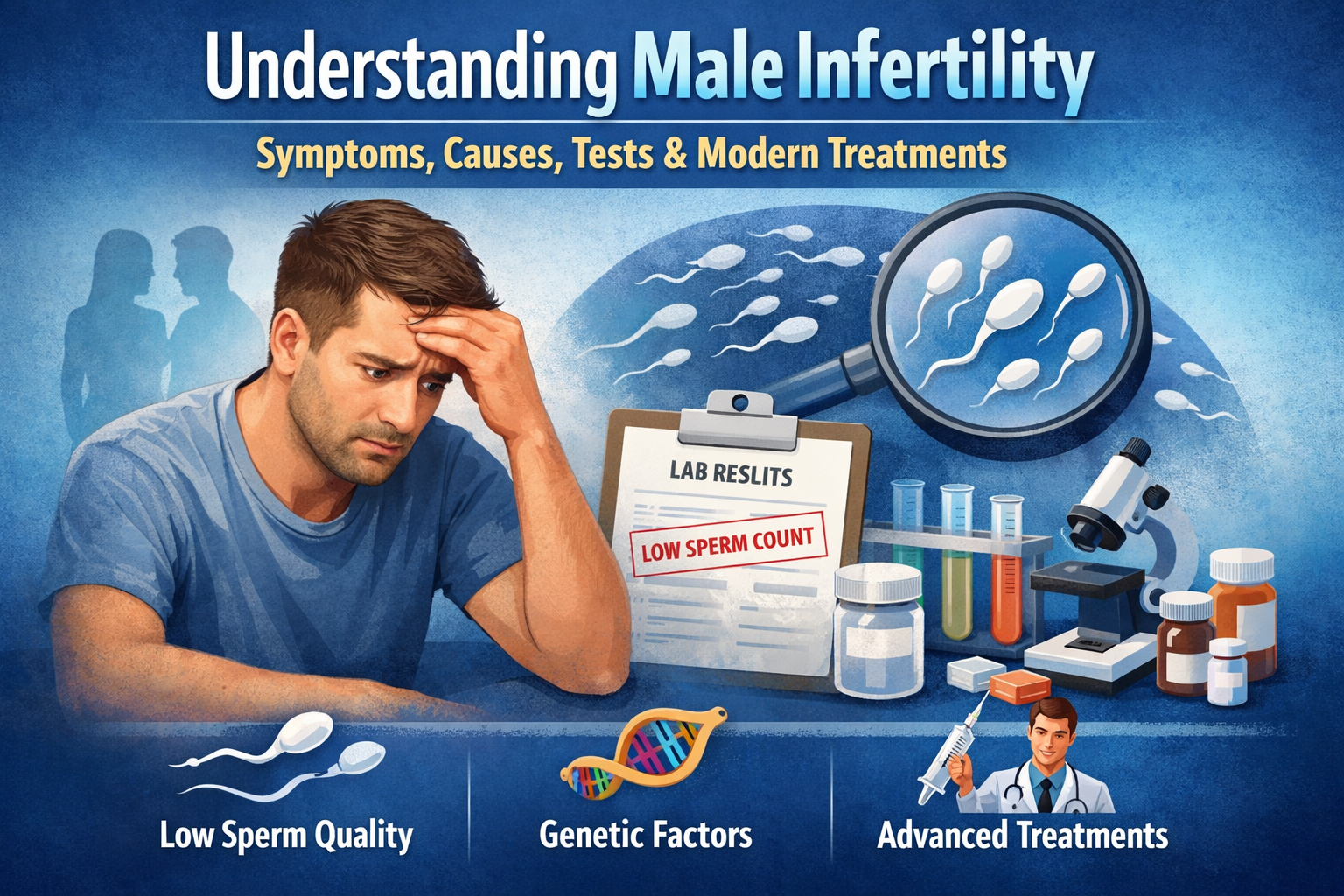
Male infertility refers to the inability of a man to impregnate a female partner despite regular, unprotected sexual intercourse for an extended period of time (usually around a year).
Some of the common causes of male infertility include –
• Low Sperm Count (Oligospermia) – Semen contains fewer sperm than normal. It can be caused by various factors such as hormonal imbalances, infections, or genetic issues.
• Poor Sperm Motility (Asthenospermia)- Sperm have difficulty moving or swimming, they may struggle to reach and fertilize the egg.
• Abnormal Sperm Morphology (Teratospermia) – Sperm with unusual shapes or abnormalities might not be able to penetrate the egg effectively.
• Absent Sperm Count (Azoospermia) – Semen does not contain any sperms. It can be obstructive or non-obstructive.
Obstructive Azoospermia – In obstructive azoospermia, there is a physical blockage that prevents sperm from reaching the semen. The testes produce sperm normally, but they are unable to be ejaculated due to an obstruction in the reproductive tract. Some common causes of obstructive azoospermia include:
• Congenital Anomalies – Some men are congenitally born with structural abnormalities in the reproductive tract, such as absence or malformation of the vas deferens (the tube that carries sperm from the testes to the ejaculatory ducts).
• Infections or Inflammation – Infections such as epididymitis or sexually transmitted infections can cause inflammation and scarring in the reproductive tract, leading to blockages.
• Previous Surgery – Surgical procedures like vasectomy, hernia repair, or other pelvic surgeries can result in scarring or obstruction in the ducts of the reproductive tract.
• Trauma – Trauma to the genital area can lead to physical damage and scarring that blocks the flow of sperm.
Non-Obstructive Azoospermia – In non-obstructive azoospermia, the testes have difficulty producing enough sperm, or there might be a problem with sperm development within the testes. In this type, there is an issue with sperm production instead of blockage. Causes of non-obstructive azoospermia include –
• Genetic Factors – Genetic conditions like Klinefelter syndrome, Y-chromosome microdeletions, and other chromosomal abnormalities can disrupt normal sperm production.
• Hormonal Imbalances – Hormonal disorders such as hypogonadotropic hypogonadism, where the brain doesn’t produce enough hormones necessary for sperm production, can lead to non-obstructive azoospermia.
• Testicular Disorders – Conditions like testicular atrophy, inflammation (orchitis), or trauma can impair the testes’ ability to produce sperm.
• Environmental Factors – Exposure to certain environmental toxins, radiation, or chemicals can impact sperm production.
• Idiopathic – In some cases, the exact cause of non-obstructive azoospermia cannot be identified, and it’s referred to as idiopathic.
Tests of Male Infertility
1. Semen analysis
• Primary test to evaluate male infertility
• Examine the quantity, quality, count, motility, morphology of sperms
2. Hormonal evaluation
• Assess levels of testosterone, follicle-stimulating hormone (FSH), luteinizing hormone (LH), and prolactin
• Hormone imbalances can affect sperm production and function
3. Genetic testing
• To identify genetic abnormalities like the presence of Y-chromosome microdeletions, which are associated with impaired sperm production
4. Testicular ultrasound
• Ultrasound imaging of the testicles can provide detailed information about the structure and abnormalities within the testes
• To identify issues such as testicular tumors, varicoceles (enlarged veins in the scrotum), or blockages in the reproductive tract
5. Post-ejaculation urinalysis
• To evaluate whether sperm is present in the urine after ejaculation (retrograde ejaculation). It helps determine if semen is being redirected into the bladder instead of being expelled through the penis.
6. Antisperm antibody testing
• Antisperm antibodies attack sperm, reducing their motility or ability to fertilize an egg
• Testing for antisperm antibodies can help determine if these antibodies are present in the semen or cervical mucus.
Treatment of Male Infertility
There are several treatment options in case of male infertility –
1. Medications –
A. Hormonal medications – In case of low hormones
1) Clomiphene citrate – Clomiphene citrate can be used in male infertility treatment. It helps to stimulate the production of follicle-stimulating hormone (FSH) and luteinizing hormone (LH) that increases the testosterone levels and help in increasing sperm production.
2) Aromatase inhibitors – Aromatase inhibitors (Letrozole) are medications that block the conversion of testosterone to estrogen. They can be used in cases where high levels of estrogen are contributing to male infertility. By reducing estrogen levels, aromatase inhibitors can help restore hormonal balance and improve sperm production.
3) Follicle-stimulating hormone (FSH) – FSH is a hormone which is administered via injection and stimulates the testes to produce testosterone and improve sperm production. In some cases, the pituitary gland fails to produce adequate levels of gonadotropins, leading to infertility. Gonadotropin therapy involves the use of medications such as follicle-stimulating hormone (FSH) to stimulate sperm production.
4) Human chorionic gonadotropin (HCG) – HCG is a hormone that mimics luteinizing hormone (LH). It is administered via injection and stimulates the testes to produce testosterone and improve sperm production.
2. Antibiotics – In cases where male infertility is caused by a bacterial infection, antibiotics may be prescribed depending on the specific infection to treat the infection and improve fertility.
3. Antioxidants – Antioxidants, such as vitamins C and E, coenzyme Q10, and selenium, may have a positive effect on sperm quality and fertility and helps in DNA repair.
B. Surgery –
• Varicoceles repair to block off the abnormal veins.
• Correction of obstructions in the sperm transport, Vasectomy reversal
• Retrieval of sperm from the reproductive tract by using techniques like
1) Testicular Sperm Aspiration (TESA) – TESA involves the use of a fine needle to extract sperm directly from the testicles
2) Percutaneous Epididymal Sperm Aspiration (PESA) – PESA is similar to TESA, but the needle is inserted into the epididymis, a small organ located on the back of the testicles where sperm mature and are stored
3) Testicular Sperm Extraction (TESE) – TESE involves the surgical removal of a small testicular tissue, which is then examined under a microscope to locate sperm
4) Microdissection Testicular Sperm Extraction (Micro-TESE) – Micro-TESE is a more advanced form of TESE. It involves the use of an operating microscope (on OT table) to identify and extract small amounts of testicular tissue that are most likely to contain sperm. Micro-TESE has a higher success rate in finding viable sperm compared to traditional TESE.
5) Electroejaculation – This technique is used for men who are unable to ejaculate voluntarily due to spinal cord injuries or other medical conditions. It involves applying electrical stimulation to the nerves in the rectum to induce ejaculation. The ejaculated semen is then collected for further use.
C. Assisted Reproductive Technologies (ART) – These procedures assist in achieving pregnancy by using sperm and eggs outside the body. Common ART procedures include –
1) Intrauterine Insemination (IUI) – It is the process involving the direct insertion of washed prepared sperm into the woman’s uterus at the time ofovulation to increase the chances of fertilization
2) In vitro fertilization (IVF) – It is the process involving eggs are removed from the woman’s ovaries and fertilized with sperm in an embryology laboratory setting and resulting embryos are then transferred into the woman’s uterus.
3) Intracytoplasmic Sperm Injection (ICSI) – This technique is often used in conjunction with IVF in case of abnormal sperm parameters. It involves injecting a single sperm directly into an egg to assist with fertilization.
In all cases, the treatment recommended will depend on the underlying cause of male infertility. It is important to meet the fertility specialist or urologist who specializes in reproductive medicine to determine the most appropriate treatment option for an individual’s specific situation.